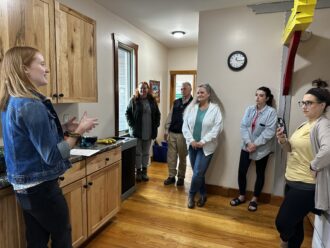
In recently completed Northeast SARE Professional Development Grant Project ENE22-178, Sprout School: Developing a Comprehensive Farm to School Toolkit for Central Appalachia, project leader Jennifer Totten, of Future Generations University, created a tool kit and training program aimed at agricultural service providers to establish Farm to School programming with farmers, school system personnel, and community volunteers.
Sprout School trained 64 service providers, across two cohorts of students, using a multi-faceted curriculum of Farm to School best practices. Out of these, 39 successfully implemented a farm to school project of their choosing and received a small stipend, while an additional 21 participated in Farm to School activities in their community without completing a project. This work led to 42 farmers reporting at least one institutional market relationship resulting in sales.This peer-learning network has morphed into a larger state wide network of roughly 120 individuals, rebuilding the start of the farm to school system in West Virginia. This is continuing into a formalized support network (the WV Farm to School Alliance/Working Group) that is supported by the Benedum Foundation, the WV Department of Agriculture, and the WV Department of Education.
Opening this network up to beyond program participants resulted in several farmers joining who are now working with their child nutrition directors on building more systems. Through this work, the next layer has been identified to increase capacity in the system surrounding school garden safety so that produce can be purchased by school systems, best practices with procurement, and increasing training for farmers who are selling into school systems as well as the nutrition staff who are interfacing with those farmers.
View the Sprout School Toolkit - https://projects.sare.org/information-product/sprout-school-toolkit
The Farm to School (F2S) movement connects schools and youth-serving institutions with local food producers, educators, and community members to integrate agriculture into educational, nutritional, and economic systems. Originating in the early 1990s, Farm to School programming now exists in all 50 U.S. states and territories and is supported by the USDA, state departments of education and agriculture, and a wide network of nonprofits, farmers, and school leaders.
Farm to School typically includes three core components and the enabling policies.
- Procurement: Schools purchasing and serving locally grown foods in cafeterias and classrooms.
- Education: Nutrition, agriculture, and environmental lessons using gardens, farms, and real world learning.
- School Gardens: Students engaging directly with food production, gardening, and food systems
on-site.
The goals of Farm to School are to increase access to fresh, healthy food for youth and educators, provide hands-on learning opportunities, support local agriculture, and build stronger school-community partnerships.