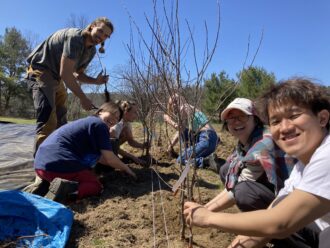
More than 300 farmers and agricultural service providers learned about agroforestry through a recently completed Northeast SARE Research and Education Grant project.
In LNE22-441, Agroforestry Transition Hub: Education and On-farm Research to Advance Agroforestry for Climate Resilience for Northeast Farmers, project leader Theresa Ong, of Darthmouth College, worked with farmers in Vermont and New Hampshire to address barriers to incorporating trees more deliberately in farm operations.
To anchor learning in place and remove key bottlenecks to adoption, the project established an Agroforestry Transition Hub that integrated demonstration sites, cohort-based education, and a local nursery. Through the nursery, the project distributed more than 3,000 trees and shrubs representing 60 species, helping ensure farmers could access plant material suited to their goals and conditions. Educational programming was organized into three cohorts: two serving resource-limited producers and one serving dairy farmers. Materials and engagement formats were tailored to each cohort’s needs.
The project team identified three recommendations to increase adoption of agroforestry on working farms.
The first recommendation is that technical assistance around agroforestry adoption should be timely, locally relevant, and relationship-based. Farmers who participated in the project found support most useful when it fit with their schedule, included site visits, and involved follow-up meetings.
The second recommendation is that financial support for adopting agroforestry should be multi-year and take into account the security of land tenure. Farmers are more interested in adoption when financing matches the timeframe required for trees to establish, reduces upfront costs, and does not penalize for slow returns. Without secure land, it is difficult for farmers to justify the expense of planting trees, since they may lose access to the fruit of their labor before it produces any fruit.
The third recommendation is that labor should be treated as core infrastructure. While trees in the long term begin to pull their own weight, the processes of establishment and early maintenance are labor-intensive. Programs that support workforce development, labor cost-shares, or low-burden designs with staged implementation can make tree planting a feasible practice.