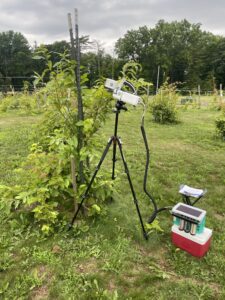
American chestnuts were wiped out by a blight in the early 1900s. This made it hard to do research on them. Now, there are versions of the American chestnut which have blight-resistant genes. A recently completed Northeast SARE Graduate Student Research grant project tested how chestnut trees can grow in cooperation with grape vines. In Co-Cultivation of Grapevines and Transgenic American Chestnuts: Improving Water Relations through Niche Facilitation, SUNY-ESF graduate student Taylor Wegner and faculty advisor John Drake studied the impact of using chestnut trees as natural scaffolding for grape vines.
Because chestnuts are moderately drought-tolerant, they are an ideal growing partner for grapes. Grape vines have large xylems and can take up vast amounts of water. In exchange for regulating the water, the chestnut provides the grape vines with an expanding trellis that lasts longer than wooden posts and is easier to avoid with a tractor. Wegner and Drake found that a single grape vine growing on a chestnut tree is, on average, more than 5 meters longer than the monoculture control vine, an increase of just over 45 percent.
This project examined whether grapevines and blight‑tolerant transgenic American chestnuts can be successfully co‑cultivated in Northeast agroforestry systems to improve water relations, crop performance, and farm diversification. By testing grape and chestnut pairings at different planting densities, the research explored whether mixed cropping could provide ecological and economic benefits compared to traditional monocultures. The study found that low‑density co‑cultivation (one grapevine per chestnut) showed signs of mutual, though asymmetric, facilitation which improved grapevine growth without negatively affecting chestnut performance. A major insight was that planting density is critical: benefits diminished and competition increased at higher grape densities, offering farmers practical guidance on how to design viable agroforestry systems.
Our results were indicative of asymmetric competition, in that co-cultivation strongly affected the vegetative growth of grapevines in a density-dependent manner, with more limited impact on American chestnut. Although mean chestnut height and mean basal diameter did not vary significantly across the varying vine planting densities, we found a non-significant increase in mean chestnut height for trees growing in the one and three vine planting densities when compared to monoculture chestnuts, and a modest increase in chestnut basal diameter for trees grown with a single vine. Thus, there may be a real impact of density on chestnut performance that this study could not detect because of our relatively modest statistical replication. - from the project final report