Showing 21-40 of 243 results
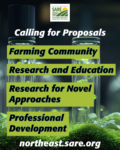
2026 Large Grant Question and Answer Sessions
Nearly seven million dollars in funding is now available for sustainable agriculture projects taking place in the Northeast beginning in 2026. Four Northeast SARE programs have released calls for proposals for projects beginning in 2026. The Farming Community, Professional Development, Research & Education, and Research for Novel Approaches Calls for Proposals have been updated for […]
2026 Farmer Grant Question and Answer Sessions
Question and Answer Sessions for the 2026 Call for Farmer Grant Proposals are taking place from noon to 1 p.m. on Tuesdays in November. Recordings from the sessions, along with questions/answers and links to referenced materials, are available
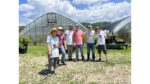
Developing an Affordable Soil Health Test
A recent Northeast SARE Research and Education project explored how small-scale farmers can better work with their soil. In LNE21-420, "Developing an Affordable Soil Health Test for the Appalachian Region to Incentivize Sustainable Agricultural Production", researchers from West Virginia University and University of Kentucky led by Dr. Eugenia Pena-Yewtukhiw from WVU worked with more than […]
New Frontiers - Tips for Proposal Success at Northeast SARE - Recording Available
The recording from the recent "New Frontiers - Tips for Proposal Success at Northeast SARE" webinar is now available. This meeting, hosted by Northeast SARE Regional Director Dr. Teresa Leslie, took place on October 23, 2025. It explains how grantmaking decisions at Northeast SARE are made, including our legislated priorities, and our emphasis on farmer […]
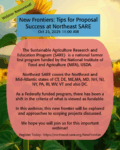
New Frontiers: Tips for Proposal Success at Northeast SARE
The Sustainable Agriculture Research and Education Program (SARE) is a national farmer first program funded by the National Institute of Food and Agriculture (NIFA), USDA. Northeast SARE covers the Northeast and Mid-Atlantic states of CT, DE, ME,MA, MD, NH, NJ, NY, PA, RI, WV, VT and also DC. As a Federally funded program, there has […]
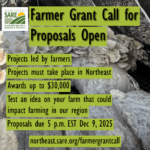
Call for 2026 Farmer Grant Proposals Now Open
Proposals due by 5 p.m. EST, Dec 9, 2025. The Northeast SARE Farmer Grant program provides funds to farmers to explore innovative concepts in sustainable agriculture conducted through experiments, surveys, prototypes, on-farm demonstrations or other research and education techniques.
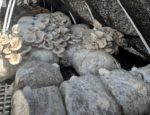
Growing Forest Mushrooms in Other Settings
A recent Northeast SARE Farmer Grant project worked with several farms to test different methods of growing mushrooms alongside other crops, as well as measuring how much profit they could bring to farmers’ bottom line. In Farmer Grant project FNE24-077, “Forest Mushroom Production On Ready-to-Fruit Blocks”, Farmer Grant Project Leader Willie Crosby, of Fungi Ally […]
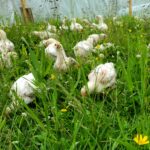
Improving Meat by Enhancing Soil
In FNE22-027, “Enhancing Health Benefits of Pasture Raised Lamb, Pork and Chicken Utilizing Organic Fish Hydrolysate and Compost Supplementation”, Karen Rodgers of MKVT Farm in Vermont tested the effectiveness of using hydrolysate made from the guts, bones, and cartilage of fish to improve soil health and increase the quality of available forage for pasture-raised animals.

Using Mycelium in Aquaculture Farming
Building on the successes of previous experiments using MycoRafts for marshland restoration and mycelium buoys for oyster farming, project leader Sue Van Hook of Greenhorns in Maine, researched a number of approaches to creating lobster buoys from mushroom mycelium – the fibrous tissue from which mushroom fruiting bodies emerge.

Expanding Aquaculture by Farming Scallops Alongside Oysters
A recent Northeast SARE aquaculture project demonstrated how Maine seafarms can farm multiple crops in the same space by raising scallops in lantern nets arranged below oyster cages. In Northeast SARE Farmer Grant FNE23-052, Growing Bay Scallops on a Maine Oyster Farm as a Strategy to Diversify Crops and Adapt to a Warming Gulf, Winnegance […]
Solar Photovoltaic Options, Opportunities and Challenges
The Solar-Clips video series explores various tips and tools for working with solar photovoltaic (PV) on your farm. This series is designed to help farmers, landowners, and agricultural service providers address the opportunities and challenges associated with on-farm solar deployment and installation. Accompanying University of Maryland Extension fact sheets from this project are below. Solar […]
Industrial Hemp In Vermont
While farmers are interested in diversifying crops by growing hemp for fiber, they lack information on the best strategies to grow and process hemp fiber in Vermont, and access new markets. The guide, Industrial Hemp in Vermont, and the videos on this page help close this knowledge gap and overcome barriers for a variety of […]
Winter Cattle Lice
Lice infestations during winter housing represent a significant challenge for cattle producers, particularly organic operations raising cattle without chemical inputs. This series of fact sheets from University of Vermont Extension describes the life cycle of cattle lice, control strategies based on integrated pest management (IPM) principles, and the use of essential oils as alternative controls. […]
Johne’s Disease Fact Sheets
Johne’s disease is an infectious disease of ruminants that reduces profitability of infected herds and is difficult to control. These University of Vermont fact sheets (combined into a 16-page PDF) answer questions about what Johne's disease is, how it spreads and how to control the disease.
UMass Soil Health Testing Guide
This guide to soil health testing was created to simplify soil health and make soil health more accessible for both educators and stakeholders. This resource is not exhaustive; the emphasis is on simple, free, chemical and physical assessments. Additional information is provided about fee-for-service laboratory tests where appropriate. Some users may find value in reviewing […]
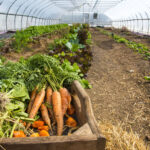
High Tunnel Production Toolkit
The following resources were developed by a team from the University of Vermont and the University of New Hampshire. The full toolkit plus additional resources for producers in Vermont, New Hampshire and Maine are available at the High Tunnel Production Toolkit website.
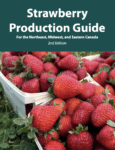
Strawberry Production Guide
Strawberry Production Guide for the Northeast, Midwest and Eastern Canada is intended as a comprehensive resource for both novice and experienced strawberry growers in northeastern North America. It provides information on all aspects of strawberry culture. The second edition has been updated and revised throughout, and includes expanded and new information on variety selection (Ch. […]
Optimizing the Economic Return of Pasture-Raised Broilers
This set of publications were developed by Cornell University and are intended to help producers of slow-growth and conventional broilers understand their costs of production and track the performance of their flocks. A third fact sheet shares guidance on breaking down a carcass into desired cuts. Calculating Costs of Production Farmers must figure out their […]
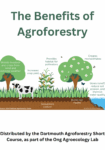
Agroforestry Transition Hub
This video introduces the Agroforestry Transition Hub at Dartmouth College, which focuses on education and on-farm research to promote transitions to agroforestry on farms in the Northeast. The project also created two zines, Common Agroforestry Practices and The Benefits of Agroforestry. Common Agroforestry Practices Zine This zine describes common agroforestry practices and shows their roots […]
Growing Seed Crops
Northeastern farmers and seed keepers are interested in increasing seed production for on-farm, community, and commercial use. This series of Cornell University fact sheets shares useful production information for a range of vegetable crops. Growing of Lettuce Seed Crop Fact Sheet Basics of Growing Carrots, Beets and Onions for Seed in the Northeast Timing of […]